

How to Prepare Your Home for Sale in Fresno: 2026 Guide

Table of Contents
- Key Points: How to Prepare Your Home for Sale in Fresno
- Understanding the Fresno Real Estate Market Before You List
- Best Time of Year to Sell a House in Fresno
- Curb Appeal Ideas for Central Valley Homes
- Decluttering, Deep Cleaning, and Staging Your Home for Fresno Buyers
- Fresno Home Inspection Checklist: What to Fix Before You List
- Pricing Your Home for the Fresno Market and Maximizing Net Proceeds
- How to Prepare Your Home for Sale in Fresno: Marketing, Showings, and Choosing Your Selling Path
- Conclusion
Last Updated: May 28, 2026
Selling your home is one of the biggest financial decisions you'll ever make, and knowing how to prepare your home for sale in Fresno gives you a real edge in a competitive Central Valley market. This guide from Parminder Kang Realtor® covers every step, from curb appeal to closing costs, so you walk away with maximum equity and fewer headaches. Most sellers underestimate how much preparation affects their final sale price. The good news: the right prep work, done in the right order, consistently attracts stronger offers and shorter days on market.
Here's what most guides get wrong: they treat home prep as a checklist of cosmetic fixes. The real work is strategic. Below, we'll show you exactly how to align your preparation with what Fresno buyers are actually looking for in 2026, including neighborhood-specific nuances, climate-driven maintenance issues, and the pricing tactics that protect your net proceeds.
Key Points: How to Prepare Your Home for Sale in Fresno
Before diving deep, here's a quick-reference summary of everything this guide covers.
| Topic | Key Action | Why It Matters |
|---|---|---|
| Market timing | List in spring or early summer | More buyers, faster sales |
| Curb appeal | Drought-tolerant landscaping | First impressions drive offers |
| Staging | Declutter and depersonalize | Buyers need to visualize themselves |
| Pricing | Use a comparative market analysis | Overpricing kills momentum |
| Inspection | Fix HVAC, roof, plumbing first | Prevents deal-killing surprises |
| Marketing | Professional photos + MLS listing | Maximum buyer exposure |
| Selling path | Agent vs. cash buyer | Depends on timeline and condition |
| Tax planning | Understand CA capital gains exclusion | Protects your net proceeds |
Understanding the Fresno Real Estate Market Before You List
Fresno's housing market in 2026 rewards sellers who do their homework. The Central Valley has seen steady demand from buyers priced out of coastal California markets, which keeps housing inventory relatively tight and median listing prices competitive. Understanding market conditions before you list is not optional. It directly shapes every decision you make, from pricing strategy to timing.
Fresno vs. Clovis: Neighborhood Nuances That Affect Your Sale
The difference between listing in Fresno proper and listing in Clovis is more significant than most sellers realize. Clovis consistently attracts buyers seeking top-rated schools, newer construction, and a suburban feel, which tends to support stronger price-per-square-foot numbers. Neighborhoods like Old Town Clovis carry a lifestyle premium that buyers will pay for.
Inside Fresno, the picture is more nuanced. Areas like Tower District appeal to buyers who want walkability and character. North Fresno neighborhoods near Shaw Avenue and Copper attract move-up buyers and families. Southeast Fresno and areas closer to downtown often attract investors and first-time buyers working with tighter budgets. Knowing where your home sits in this spectrum shapes how you price it, how you stage it, and who your likely buyer is.
How Housing Inventory and Days on Market Shape Your Strategy
Low housing inventory means buyers have fewer choices, which creates upward pressure on offers and shortens days on market. When inventory is higher, sellers need to work harder on presentation and pricing to stand out. Check current inventory levels in your specific zip code before setting your list price. A comparative market analysis from a local agent gives you the clearest picture of where you stand relative to active competition.
Best Time of Year to Sell a House in Fresno
The best time of year to sell a house in Fresno is late March through June. Spring listings in the Central Valley benefit from mild weather, active buyer demand, and the natural motivation of families wanting to move before the school year ends.
Summer can still produce strong results, but Fresno's triple-digit heat creates a practical challenge: buyers are less enthusiastic about attending open houses when it's 105 degrees outside. Fall listings are viable but face shrinking buyer pools. Winter is the slowest period, though serious buyers who are searching in December and January tend to be motivated, which can work in a seller's favor.
According to National Association of Realtors housing data, spring consistently produces the highest sale prices and shortest days on market across most U.S. markets, and Fresno follows this national pattern closely.
The practical implication: if you're planning to sell, start your preparation work in January or February so you're ready to list by late March. Rushing your prep to hit the spring market and listing an unprepared home is a common mistake that costs sellers real money.
Curb Appeal Ideas for Central Valley Homes
First impressions happen before a buyer ever walks through your front door, and in Fresno, curb appeal is shaped by realities that no national guide accounts for: 110-degree July afternoons, alkaline clay soils, hard water staining on concrete and stucco, and a regional aesthetic that skews toward low-water landscaping over the lush green lawns common in coastal California listings. Buyers touring Fresno homes in summer are already hot and skeptical. Your exterior has to signal "well-maintained" and "low future cost" within the first ten seconds.
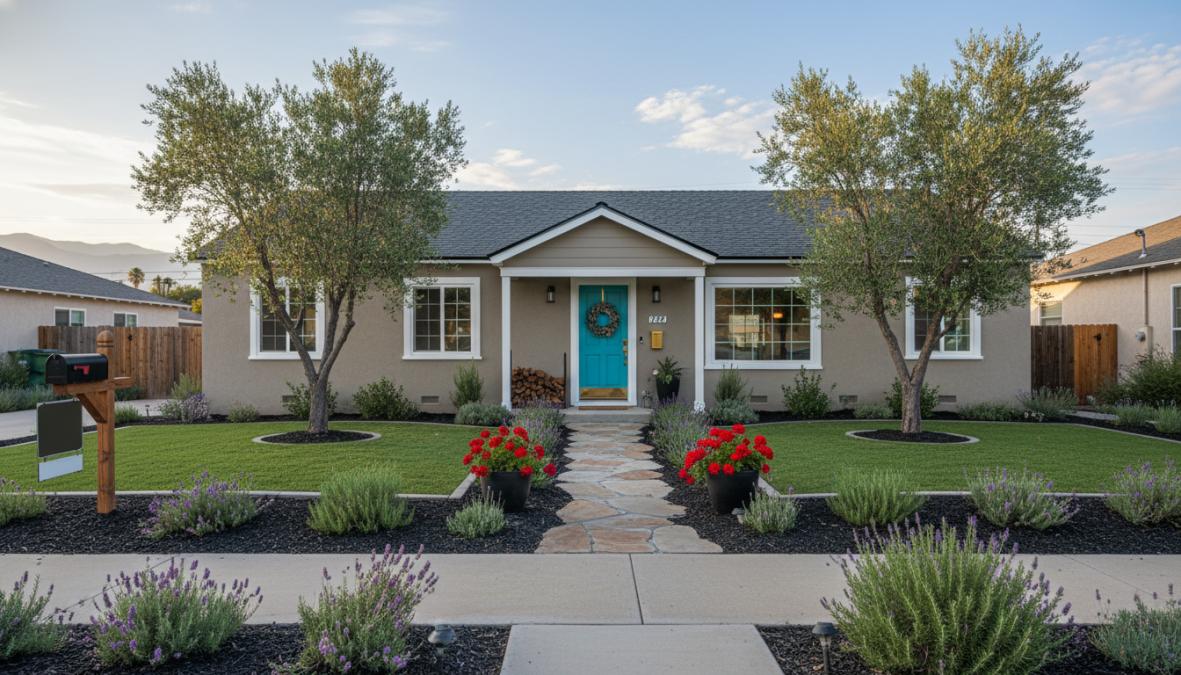
Replace Thirsty Turf, But Do It Strategically
Buyers in the Central Valley are water-bill aware. A front yard dominated by Kentucky bluegrass or fescue signals ongoing expense and potential HOA or city water-restriction issues. Replacing it entirely with decomposed granite (DG) is the fastest fix, but a yard that is 100% gravel reads as neglected in listing photos. The highest-performing approach for Fresno listings is a layered design: DG or crushed rock as the base, with defined planting beds using species that thrive in USDA Hardiness Zone 9b, which covers most of the Fresno metro.
Specific plants that photograph well, survive Fresno summers without irrigation drama, and appeal to buyers:
- Lavender (Lavandula angustifolia or 'Phenomenal' variety): Blooms spring through early summer, handles reflected heat from stucco walls, and photographs with strong color contrast against gravel.
- Agave (Agave americana or blue agave): Architectural shape reads well in listing photos. Requires essentially no supplemental water once established.
- Mexican sage (Salvia leucantha): Purple spikes from late summer through fall, useful if you're listing in August or September when most other plants look stressed.
- Ornamental grasses (Muhlenbergia capillaris, 'Karl Foerster' feather reed grass): Movement in photos, low water, and they don't look dead in August the way annual color plants do.
- Dwarf citrus in containers near the entry: A potted Meyer lemon or kumquat near the front door is a distinctly Central Valley touch that resonates with local buyers and photographs warmly.
Avoid planting anything new within four weeks of your listing date. Freshly planted material looks sparse in photos and may not survive if you're listing in summer without a reliable irrigation schedule.
Hard Water and Stucco Staining: The Curb Appeal Problem Nobody Mentions
Fresno's municipal water supply is high in dissolved minerals. Over time, irrigation overspray leaves white calcium deposits on stucco, brick, and concrete flatwork that look like neglect in listing photos even when the home is otherwise well-maintained. Before your photographer arrives:
- Apply a diluted white vinegar solution or a commercial calcium/lime remover (CLR is widely available) to stucco staining. Test on an inconspicuous area first, some painted stucco finishes are sensitive.
- Power wash driveways and walkways, then treat any remaining white mineral rings with an acid-based concrete cleaner.
- Check irrigation heads and adjust spray patterns so they're not hitting the house foundation or walkways. Buyers and inspectors notice active irrigation overspray.
Climate-Specific Prep: Surviving Fresno's Heat Before Listing
Fresno's climate creates specific maintenance issues that buyers and home inspectors will notice. Heat stress cracks stucco and wood trim. Intense UV exposure fades paint and degrades caulking around windows and doors. Before listing, walk your home's exterior and look for:
- Cracked or spalling stucco: Common on homes built before 2000, especially on south- and west-facing walls that absorb the most afternoon sun. Small hairline cracks can be patched with elastomeric caulk and painted over. Larger cracks or areas where the stucco is separating from the substrate need a stucco contractor.
- Faded or chalking exterior paint: Chalking (a powdery residue that comes off on your hand when you rub the wall) means the paint binder has broken down from UV exposure. A fresh coat of exterior paint is one of the highest-ROI improvements a Fresno seller can make, it photographs dramatically better and signals recent maintenance to buyers.
- Dried-out caulking around window frames and door frames: Fresno's temperature swings, from freezing winter nights to 110-degree summer days, cause caulk to shrink and crack faster than in coastal climates. Open gaps will be flagged by home inspectors as potential water intrusion points.
- HVAC condenser unit appearance: The outdoor AC condenser is visible from the side or rear yard and is often included in listing photos. A unit surrounded by dead weeds, with bent fins and a rusted housing, signals deferred maintenance to buyers before they ever ask about the system's age. Clear vegetation at least 18 inches around the unit, straighten bent condenser fins with a fin comb (available at any hardware store), and consider a light cleaning of the exterior housing.
- Roof condition from the street: You don't need to get on the roof, but walk to the curb and look. Missing or cracked tiles, visible granule loss on asphalt shingles, and sagging ridgelines are all visible from the ground and will be the first things a buyer's inspector photographs.
Front Door and Entry: The Highest-ROI Single Upgrade
Real estate practitioners consistently identify front door replacement or repainting as one of the highest-return cosmetic improvements a seller can make, and this holds especially true in Fresno where sun-bleached, faded doors are common. If your door is solid wood and in good structural condition, a fresh coat of exterior paint in a strong accent color (deep navy, forest green, matte black, or a warm terracotta that complements stucco) costs under $100 in materials and transforms listing photos. If the door is hollow-core, warped, or has a dated oval glass insert, replacement is worth considering, a new fiberglass entry door with a clean, modern profile signals move-in readiness.
Pair the door update with:
- New house numbers in a brushed nickel or matte black finish (old brass numbers photograph poorly)
- A new exterior light fixture if the current one is dated or corroded
- A simple doormat and one or two potted plants flanking the entry
These three elements together cost well under $500 and consistently appear in the listing photos that generate the most showing requests.
Decluttering, Deep Cleaning, and Staging Your Home for Fresno Buyers
Staging is not about decorating. It's about removing anything that prevents a buyer from picturing themselves living in your home. The fastest way to lose a buyer is to make them feel like a guest in someone else's house.
Start with decluttering, room by room. The standard rule: if you haven't used it in 12 months, it goes into storage or donation. This includes furniture. Oversized or excess furniture makes rooms feel smaller in listing photos and during showings.
Deep cleaning follows decluttering. Hire a professional cleaning service if you can. Pay special attention to:
- Kitchen appliances, inside and out
- Grout lines in bathrooms and kitchens
- Window tracks and sills (Fresno's dust makes these noticeably dirty)
- Baseboards and ceiling fans
- HVAC vents and returns

Room-by-Room Staging Checklist
Use this checklist before every showing:
Living Room:
- Remove personal photos and memorabilia
- Clear all surfaces except 1-2 decorative items
- Arrange furniture to create a clear traffic flow
- Add a neutral throw and simple cushions
Kitchen:
- Clear all countertops (store appliances you use daily)
- Clean inside cabinets (buyers open them)
- Add a simple fruit bowl or fresh flowers
- Replace any dated cabinet hardware
Master Bedroom:
- Use neutral bedding
- Clear nightstands down to one item each
- Remove excess furniture if the room feels crowded
Bathrooms:
- Remove all personal products from counters and shower
- Add fresh white towels folded neatly
- Replace toilet seats if worn or stained
- Add a simple candle or small plant
Garage:
- Clear and organize (buyers assess storage capacity)
- Sweep the floor
- Remove excess items to storage
Fresno Home Inspection Checklist: What to Fix Before You List
A pre-listing home inspection is one of the smartest moves a Fresno seller can make. It surfaces problems before a buyer's inspector finds them, giving you control over how repairs are handled and priced. Surprises during escrow kill deals or force last-minute price concessions, often at a multiple of what the repair would have cost if you'd handled it proactively.
What makes Fresno's inspection landscape different from a generic national checklist is the combination of extreme climate stress, local soil conditions, and California's disclosure requirements. A buyer's inspector working in the Central Valley knows exactly what to look for here. You should too.
1. HVAC System, The Non-Negotiable
Fresno summers regularly exceed 105 degrees Fahrenheit. A failing or undersized air conditioning system is not a negotiating chip, it is a deal-breaker for most buyers, and it will appear prominently in any inspection report. Before listing:
- Schedule a professional HVAC service call. Have a licensed HVAC technician check refrigerant levels, clean coils, inspect the blower motor, and verify that the system is cooling to its rated capacity. Ask for a written service report, you can provide this to buyers as evidence of recent maintenance.
- Check system age. Most buyers and their agents know that a central AC unit in Fresno's climate has a functional lifespan of roughly 12 to 15 years under heavy use. If your unit is approaching or past that range, price your home with that in mind or budget for a proactive replacement. A new system is a marketable feature; a 17-year-old unit with deferred service is a liability.
- Verify adequate sizing. Homes that have been added onto, had rooms converted, or had windows replaced with larger units sometimes have HVAC systems that are no longer properly sized for the conditioned space. An undersized system that runs continuously during a summer showing will be noticed immediately.
- Replace filters and clean vents. Dusty return vents and clogged filters are minor items that inspectors photograph and buyers remember. Clean them before any showings, not just before the inspection.
2. Roof, Heat Cycling and UV Degradation
Fresno's combination of intense UV radiation and wide seasonal temperature swings degrades roofing materials faster than in coastal California climates. Asphalt shingles lose granules more quickly, tile mortar dries and cracks, and flashing sealants around vents and chimneys deteriorate. Have a licensed roofing contractor assess:
- Remaining useful life of the roofing material (inspectors will estimate this; know the number before they do)
- Condition of flashing around the chimney, skylights, and HVAC penetrations
- Any areas of granule loss, cracked tiles, or lifted shingles
- Gutters and downspouts, clogged gutters cause fascia rot and are a common inspection flag
If your roof is within a few years of end-of-life, you have three options: replace it proactively and market it as a selling point, price the home to reflect the remaining life, or offer a seller credit. What you cannot do effectively is ignore it, buyers in Fresno are aware of roofing costs and will factor a near-end roof into their offer.
3. Foundation, Fresno's Clay Soil Problem
This is the Fresno-specific issue that generic inspection checklists miss entirely. The San Joaquin Valley floor is underlain by expansive clay soils that swell when wet and shrink when dry. Fresno's cycle of wet winters and bone-dry summers means these soils move seasonally, and homes built on them, particularly those built before modern foundation engineering standards, show the effects over time.
What to look for before your buyer's inspector does:
- Diagonal cracks at door and window corners: The classic sign of differential foundation movement. Small, stable cracks (hairline, not widening) are common and often cosmetic. Cracks wider than 1/4 inch, or cracks that have grown visibly over time, warrant evaluation by a licensed structural engineer or foundation specialist.
- Doors and windows that stick or don't close squarely: Seasonal sticking (worse in summer when the soil is driest) is common in older Fresno homes. Persistent sticking year-round can indicate ongoing movement.
- Gaps between the wall and ceiling or floor: Separation at these joints, especially in older homes, can indicate settling.
If you have visible foundation cracking, do not attempt to hide it. California's seller disclosure requirements are explicit, and concealing known material defects is a legal liability that survives the close of escrow. Instead, get a written evaluation from a licensed professional. A report that says "cracks are cosmetic and stable" is a document you can hand to buyers. Silence on the topic invites worst-case assumptions.
4. Plumbing, Hard Water Damage Is Underestimated
Fresno's water supply is high in dissolved calcium and magnesium. Over years, hard water deposits accumulate inside water heaters, reducing efficiency and shortening lifespan. They also build up in fixture aerators, showerheads, and supply valves. Before listing:
- Check water heater age and condition. A water heater more than 10 to 12 years old in a hard-water market like Fresno is likely operating below rated efficiency and will be flagged by inspectors. Flush the tank to remove sediment buildup. If the unit is near end-of-life, replacement is worth considering, it's a visible, concrete improvement buyers appreciate.
- Inspect under sinks for supply line corrosion. Braided stainless supply lines corrode at the fittings in hard-water environments. Replace any that show white mineral buildup at the connections.
- Clean or replace aerators and showerheads. Mineral-clogged fixtures reduce water pressure noticeably during showings and signal maintenance neglect.
- Check for slow drains. Slow drains in multiple fixtures can indicate a main line issue. A plumber can camera the main sewer line for a few hundred dollars, money well spent if your home is older or has mature trees near the sewer lateral.
5. Electrical Panel, Know What You Have
Older Fresno homes, particularly those built in the 1960s through 1980s, may have electrical panels that inspectors and buyers' lenders flag. Specific items to verify:
- Panel brand and type: Certain panel brands from that era have documented reliability issues and may affect your ability to obtain homeowner's insurance or satisfy lender requirements. A licensed electrician can evaluate your panel and advise on whether replacement is warranted.
- Adequate amperage for modern loads: Homes with 100-amp service that have added HVAC systems, EV chargers, or large appliances may be running at or near capacity. Buyers with modern electrical demands will notice.
- GFCI protection in kitchens, bathrooms, and exterior outlets: California code requires GFCI protection in these locations. Missing GFCI outlets are a standard inspection flag and an inexpensive fix.
6. California Seller Disclosure Requirements
California law requires sellers to complete a Transfer Disclosure Statement (TDS) and, in many cases, a Natural Hazard Disclosure (NHD) report. Fresno County has specific natural hazard designations, including flood zone classifications along the San Joaquin River corridor and areas with documented soil liquefaction or subsidence risk, that must be disclosed if applicable to your property.
As noted in California Department of Real Estate seller disclosure requirements, sellers have an affirmative duty to disclose known material facts that affect the property's value or desirability. This obligation does not end at closing, buyers who discover undisclosed defects after the sale have legal recourse.
Complete your disclosures accurately and early in the process. Buyers who receive complete disclosures upfront are more confident, less likely to back out during the inspection period, and less likely to pursue post-closing claims.
Fresno Pre-Listing Inspection Priority Matrix
| System | Fresno-Specific Risk | Action Before Listing |
|---|---|---|
| HVAC | High, extreme heat demand, accelerated wear | Professional service + written report |
| Roof | High, UV and heat cycling | Contractor assessment; repair or price accordingly |
| Foundation | Medium-High, expansive clay soils | Visual inspection; engineer eval if cracks present |
| Water heater | Medium, hard water sediment buildup | Flush tank; replace if over 10-12 years old |
| Electrical | Medium, older panel brands, amperage | Electrician eval if home is pre-1990 |
| Plumbing | Medium, hard water corrosion, tree roots | Under-sink inspection; sewer camera if older home |
| Exterior caulk/stucco | Medium, UV and temperature cycling | Walk exterior; re-caulk all open joints |
Pricing Your Home for the Fresno Market and Maximizing Net Proceeds
Pricing is where sellers most often leave money on the table, or worse, kill their sale entirely. Overpricing is the single most common mistake. A home priced above market value sits. Days on market accumulate. Buyers assume something is wrong. Price reductions signal weakness and attract lowball offers.
The right approach is a comparative market analysis (CMA) based on recent sales of similar homes in your specific neighborhood. Not Fresno broadly. Your zip code. Your street, if possible. A CMA accounts for square footage, lot size, condition, age, and features to arrive at a realistic market value.
Your net proceeds are what matters, not your list price. Factor in:
- Real estate agent commissions
- Closing costs (title insurance, escrow fees, transfer taxes)
- Any seller concessions you offer buyers
- Repair credits negotiated after inspection
- Remaining mortgage balance
Tax Implications for California Home Sellers
This is the part most sellers don't think about until it's too late. California has specific tax implications for home sellers that directly affect your net proceeds.
The federal capital gains exclusion allows single filers to exclude up to $250,000 in profit from the sale of a primary residence, and married couples filing jointly can exclude up to $500,000, provided you've lived in the home as your primary residence for at least two of the last five years. California does not have a separate capital gains rate. Gains are taxed as ordinary income at the state level, which can be significant for long-term owners who've built substantial equity.
Property records in California are public, so buyers can research your purchase price. This doesn't affect your sale directly, but it's worth knowing.
For sellers who've owned their home for many years and have significant appreciation, consulting a CPA before listing is money well spent. The timing of your sale, and which tax year it falls in, can affect your tax liability.
As noted in IRS Publication 523 on selling your home, the primary residence exclusion has specific requirements around ownership and use that sellers should verify before assuming they qualify.
How to Prepare Your Home for Sale in Fresno: Marketing, Showings, and Choosing Your Selling Path
Getting your home ready is only half the equation. How you market it and manage the selling process determines whether all that prep work converts into strong offers.
Digital Marketing Plan and MLS Listing Tips
The MLS listing is your primary marketing vehicle. Every buyer's agent in Fresno searches the MLS, and most buyer-facing real estate platforms pull directly from it. A weak MLS listing, with poor photos, thin description, or missing details, costs you buyer attention before they ever schedule a showing.
A strong digital marketing plan for your Fresno home includes:
- Professional photography: This is non-negotiable. Phone photos lose buyers. Professional real estate photography consistently produces more showing requests.
- Virtual tours: Increasingly expected by buyers, especially those relocating from out of the area. A 3D virtual tour lets buyers pre-qualify your home before visiting in person, which means the buyers who do show up are more serious.
- Accurate and complete MLS data: Square footage, lot size, school district, HOA details, year built, and recent upgrades should all be listed accurately. Errors create friction during escrow.
- Social media exposure: Listing promotion on Facebook and Instagram reaches local buyers who may not be actively searching the MLS but are open to moving.
Managing home showings and open houses requires flexibility. The more accessible your home is for showings, the faster it sells. Restricting showing windows limits buyer exposure and extends days on market.
Cash Home Buyer vs. Traditional Real Estate Agent: Which Is Right for You?
The right selling path depends on your priorities. Here's the honest breakdown.
Traditional real estate agent: Best for sellers who want maximum market value and can afford to wait 30-60 days for the right offer. A skilled local agent handles pricing, marketing, negotiation, and transaction management. The trade-off is time and the cost of preparation and commissions.
Cash home buyer or iBuyer: Best for sellers who need speed, want to avoid showings, or have a property in poor condition that won't compete well on the open market. Cash buyers typically offer below market value in exchange for convenience and certainty. There are no showings, no contingencies, and no waiting for buyer pre-approval or financing.
| Selling Path | Timeline | Net Proceeds | Prep Required | Best For |
|---|---|---|---|---|
| Traditional agent | 30-60 days | Highest | High | Sellers prioritizing price |
| Cash home buyer | 7-14 days | Below market | Minimal | Sellers prioritizing speed |
| iBuyer | 14-30 days | Near market | Low-moderate | Sellers wanting convenience |
Most Fresno sellers who've properly prepared their home and priced it correctly do better financially with a traditional sale. The gap between cash offers and market value in the Central Valley is real, and for a well-prepared home, it's rarely worth giving up.
According to Consumer Financial Protection Bureau guide to selling your home, sellers should carefully compare net proceeds across selling options before committing to any path, accounting for all fees and concessions.
Parminder Kang Realtor® works with sellers across Fresno, Clovis, and the broader Central Valley to determine which path serves their goals. With deep knowledge of every neighborhood and current price trends, the team provides a free home valuation that gives you a clear starting point before you make any decisions.
Preparing your home for sale in Fresno involves more moving parts than most sellers anticipate, from climate-specific maintenance to California's tax rules to choosing the right selling strategy for your situation. Parminder Kang Realtor® helps sellers across Fresno and Clovis navigate every stage of this process, backed by local market expertise and a free home valuation report that shows you exactly where your home stands before you list. Get your free home valuation from Parminder Kang Realtor® and start your sale with a clear, confident strategy.
Frequently Asked Questions
What are the most important home improvements for selling in Fresno?
When preparing your home for sale in Fresno, focus on high-impact, low-cost improvements first: fresh interior and exterior paint in neutral tones, updated fixtures, repaired flooring, and a deep-cleaned kitchen and bathrooms. Curb appeal upgrades like drought-tolerant landscaping and a clean driveway matter significantly in the Central Valley's hot climate. Avoid over-improving, a comparative market analysis from a local real estate agent can help you identify which upgrades actually increase your market value versus which ones won't deliver a return.
Do I need to stage my home to sell it in Fresno?
Staging is not legally required, but it can meaningfully reduce your days on market and improve buyer perception. In the Fresno real estate market, staged homes tend to photograph better for MLS listings and virtual tours, which drives more showing requests. At minimum, decluttering, deep cleaning, and depersonalizing every room functions as basic staging. If your budget allows, professional staging of the living room, primary bedroom, and kitchen typically offers the strongest return for Fresno and Clovis sellers.
What documents do I need to sell a house in Fresno, CA?
To sell a house in Fresno, California, you'll generally need your property deed, mortgage payoff statement, HOA documents (if applicable), a seller's disclosure form, a natural hazard disclosure report, and any permits for past renovations. Your escrow and title insurance company will also require a preliminary title report. California law requires specific disclosures, so working with a licensed real estate agent familiar with Fresno property records and local regulations helps ensure nothing is missed during the transaction.
When is the best time of year to sell a house in Fresno?
The best time of year to sell a house in Fresno is typically late spring through early summer, roughly March through June. Buyer activity peaks during this window, housing inventory is more competitive, and homes often sell closer to or above their median listing price. That said, Fresno's relatively mild winters compared to national averages mean fall listings can also perform well. Consulting a local real estate agent for a current comparative market analysis is the best way to time your specific listing.
Should I get a home inspection before listing in Fresno?
A pre-listing home inspection is strongly recommended when preparing your home for sale in Fresno. Using a Fresno home inspection checklist before buyers conduct their own inspection lets you identify and repair issues proactively, preventing price renegotiations or deal collapses during escrow. Common issues in Central Valley homes include HVAC wear from extreme heat, roof sun damage, and aging plumbing. Addressing these upfront can protect your net proceeds and give buyers greater confidence, often resulting in cleaner, faster offers.
How much does it cost to prepare a house for sale in Fresno?
Costs to prepare your home for sale in Fresno vary widely based on your home's condition. Basic preparation, deep cleaning, decluttering, minor repairs, and fresh paint, can run a few hundred to a few thousand dollars. Professional staging typically adds $1,000-$3,000 depending on home size. Pre-listing inspections average a few hundred dollars. Larger repairs like HVAC servicing or roof work cost more but can protect your equity at closing. A local real estate agent can help you prioritize spending for maximum return.
This article was written using GrandRanker
Categories
Recent Posts