
8 Steps to Finding Investment Properties in Fresno
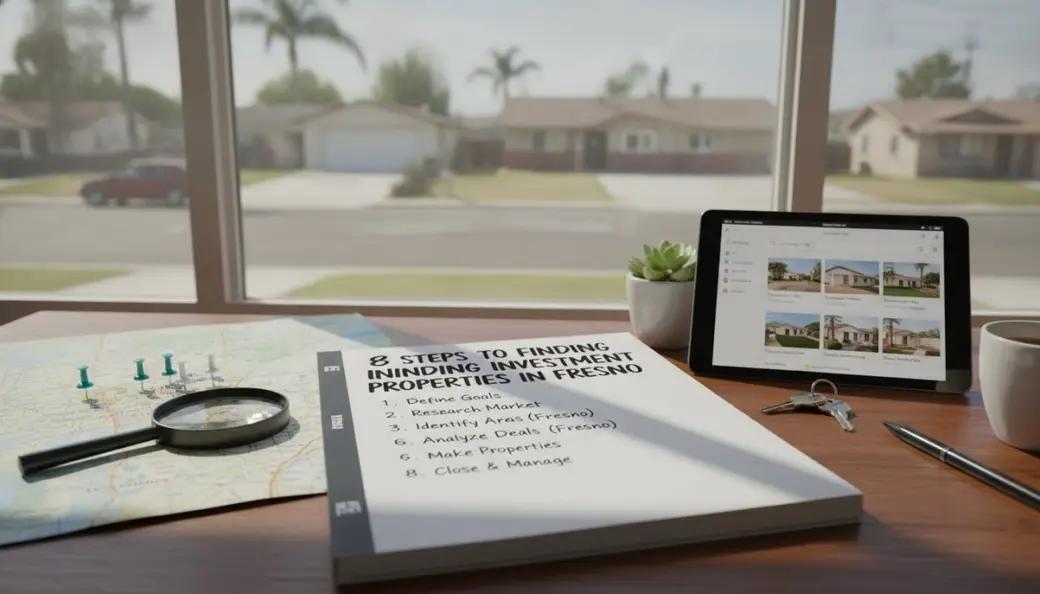
Table of Contents
- Why Fresno Real Estate Market Trends Make This the Right Time to Invest
- 8 Steps to Finding Investment Properties in Fresno That Actually Cash Flow
- Step 1: Define Your Investment Goals and ROI Criteria
- Step 2: Understand Your Financing Options, From Conventional Loans to Bridge Loans
- Step 3: Set Your Investment Criteria and Deal Calculator Benchmarks
- Step 4: Run a Targeted Property Search in the Right Fresno Submarkets
- Step 5: Perform Thorough Due Diligence and Property Inspection
- Step 6: Understand the Regulatory Environment and California-Specific Rules
- Step 7: Factor In Tax Implications for California Investors
- Step 8: Close the Deal and Plan for Portfolio Scaling
- Best Neighborhoods for Rental Properties in Fresno
- How to Analyze Rental Property Deals in Fresno Like a Pro
- Property Management vs. Self-Management in the Central Valley
- Working with a Local Real Estate Agent on the 8 Steps to Finding Investment Properties in Fresno
- Conclusion
Last Updated: June 18, 2026
Fresno's real estate market has quietly become one of the most compelling investment destinations in California, and the 8 steps to finding investment properties in Fresno outlined in this guide will show you exactly why. This guide from Parminder Kang Realtor® covers the full process, from setting your investment goals to closing your first deal and scaling beyond it. Most national real estate guides treat Fresno like a footnote, that's a mistake local investors are profiting from.
Why Fresno Real Estate Market Trends Make This the Right Time to Invest
Fresno sits at a unique intersection: one of the few major California cities where median home prices remain accessible compared to the Bay Area and Los Angeles, yet rental demand is strong enough to support positive cash flow on well-selected properties. That gap is narrowing, making 2026 a critical window.
According to California Association of Realtors housing market data, Central Valley markets including Fresno have seen sustained demand from both owner-occupants and renters, fueled by migration from higher-cost coastal cities, new residents who need housing quickly and aren't ready to buy.
Median Home Prices, Inventory Supply, and What They Mean for Investors
Fresno's inventory has stayed lean, keeping vacancy rates low for landlords who price competitively. For investors, low inventory means less competition from owner-occupants on duplexes, triplexes, and value-add single-family homes, exactly where equity gets built and cash flow becomes realistic.
8 Steps to Finding Investment Properties in Fresno That Actually Cash Flow
Investment property in Fresno is a step-by-step process, not a single decision. Skipping steps, especially due diligence and financing preparation, is the most common reason first-time investors overpay or buy properties that drain cash.
Step 1: Define Your Investment Goals and ROI Criteria
Before you look at a single listing, get clear on what you want. Are you chasing monthly cash flow, long-term appreciation, or both? Set your benchmarks in writing before you open Zillow, without defined ROI criteria, you'll rationalize bad deals.
Ask yourself:
- Do I want passive income now, or am I building equity for a future sale?
- Am I comfortable managing tenants, or do I need to budget for property management?
- What's my target holding period: 3 years, 10 years, indefinitely?
Step 2: Understand Your Financing Options, From Conventional Loans to Bridge Loans
Conventional loans work well for stabilized properties, but value-add deals often require bridge loans or hard money lending during renovation, followed by a refinance once the property is stabilized.
Key financing types to understand:
- Conventional investment loans: Typically require 20-25% down, best for move-in ready rentals
- Bridge loans: Short-term, higher rate, ideal for value-add acquisitions
- DSCR loans: Qualify based on property income, not personal income, useful for portfolio investors
- FHA/203k: Only for owner-occupants, not applicable for pure investment plays
As noted by National Association of Realtors investment property financing guide, having pre-approval in place before making offers dramatically improves your negotiating position in competitive markets.
Step 3: Set Your Investment Criteria and Deal Calculator Benchmarks
A deal calculator forces you to run numbers before you fall in love with a property. Your investment criteria should define:
- Minimum cap rate (many Fresno investors target 5-7% depending on submarket)
- Maximum price per unit for multifamily
- Maximum rehab budget as a percentage of ARV
- Required cash-on-cash return in year one
Run every property through your calculator before scheduling a showing. If the numbers don't work on paper, they won't work in real life.
Step 4: Run a Targeted Property Search in the Right Fresno Submarkets
Not all Fresno zip codes perform equally. Investors chasing cash flow find better numbers in Central and Southeast Fresno, where prices are lower and rental demand from working families is consistent. Investors prioritizing appreciation focus on Clovis, Woodward Park, and the Clovis Unified School District zone.
For a targeted search, filter by:
- Property type (single-family, duplex, triplex, small multifamily)
- Year built (pre-1980 properties often need more capex but offer better pricing)
- Days on market (longer DOM can signal motivated sellers)
- Proximity to employment centers, hospitals, and Fresno State
Step 5: Perform Thorough Due Diligence and Property Inspection
A thorough property inspection in Fresno should go beyond the standard home inspection. Older Central Valley properties frequently have deferred maintenance including roof wear, aging HVAC, and foundation concerns related to regional soil conditions. Order a sewer scope on any property built before 1985.
Due diligence checklist for Fresno investment properties:
- Full home inspection with licensed California inspector
- Sewer scope (especially pre-1985 construction)
- Roof inspection and remaining life estimate
- HVAC condition and age verification
- Review of current leases and rent rolls (for tenant-occupied properties)
- Verify current rents against market rents
- Check for any unpermitted additions or work
- Review title report for liens or encumbrances
Step 6: Understand the Regulatory Environment and California-Specific Rules
AB 1482 caps annual rent increases at 5% plus local CPI (10% maximum) for qualifying properties, most multifamily buildings built before 2007 are covered, while single-family homes owned by individual landlords are generally exempt. Knowing whether your target property falls under AB 1482 directly affects your revenue projections.
Just cause eviction requirements also apply to most rentals after 12 months of occupancy. Factor this into your tenant screening process and vacancy assumptions. Additionally, Fresno's Housing Choice Voucher (Section 8) program offers government-backed rent payments and strong tenant demand worth evaluating as part of your strategy.
Step 7: Factor In Tax Implications for California Investors
California taxes real estate investment income as ordinary income with some of the nation's highest capital gains rates. Your after-tax returns must be part of the analysis from day one.
Key tax considerations for California real estate investors:
- Depreciation: Residential rental property depreciates over 27.5 years, offsetting rental income
- 1031 exchanges: Defer capital gains taxes by rolling proceeds into a like-kind replacement property
- California property tax: Proposition 13 limits annual increases to 2% of assessed value, benefiting long-term holders
- Passive activity rules: Rental income and losses are generally classified as passive, with deductibility subject to income thresholds
Work with a California CPA who specializes in real estate before you close your first deal. As outlined by IRS publication on rental income and expenses, understanding depreciation and passive activity rules is foundational for any residential rental investor.
Step 8: Close the Deal and Plan for Portfolio Scaling
When buying a tenant-occupied property, confirm security deposit status and verify all required California disclosures have been provided. Once you close, the scaling mindset starts immediately.
Many Fresno investors use the BRRRR strategy (Buy, Rehab, Rent, Refinance, Repeat) to recycle capital and grow a portfolio without large amounts of new cash for each acquisition. Portfolio scaling in the Central Valley also means diversifying across Fresno, Clovis, Madera, and Sanger to spread risk across different market dynamics within a manageable geographic area.
Best Neighborhoods for Rental Properties in Fresno
The best neighborhoods vary significantly based on your investment strategy, target tenant profile, and risk tolerance. Cash flow investors and appreciation investors are looking for fundamentally different things.

Tower District, Woodward Park, and Clovis Unified School Zone
Tower District attracts young professionals and creative-sector renters who value walkability, with consistent demand and low vacancy. Woodward Park appeals to families wanting newer construction and proximity to employers along the Highway 41 corridor. The Clovis Unified School District zone is a powerful rental demand driver, families relocate specifically for those schools, creating a tenant base that stays longer and treats properties with more care. Entry prices are higher and cap rates thinner, but management intensity is lower.
Multifamily Opportunities in Central and Southeast Fresno
Central and Southeast Fresno offer the best cash flow numbers in the market. Prices per unit are lower, rental demand from working families and essential workers is steady, and the inventory of older duplexes and small apartment buildings gives investors options that don't exist in higher-priced submarkets. The trade-off is higher management intensity and more active tenant screening. Madera and Sanger, just outside Fresno's city limits, are also worth watching, tight rental markets and fewer competing investors can mean better acquisition pricing.
How to Analyze Rental Property Deals in Fresno Like a Pro
Analyzing rental property deals requires a consistent framework applied to every property without exception. Investors who get burned run numbers loosely on deals they're excited about and rigorously on deals they're skeptical of.

Cash Flow, Equity, and Passive Income: Running the Numbers
Cash flow is gross rent minus all expenses, and investors consistently underestimate expenses. A realistic estimate should include:
- Property taxes (approximately 1.1-1.25% of assessed value annually under Prop 13)
- Insurance
- Property management (typically 8-10% of collected rent if outsourced)
- Maintenance and repairs (budget 1% of property value annually)
- Vacancy allowance (5-8% of gross rent)
- Capital expenditure reserves (roof, HVAC, appliances)
If the property still produces positive monthly cash flow after all of these, it's worth serious consideration. Equity growth adds to total return, but cash flow is what keeps you solvent.
| Analysis Metric | Target Range (Fresno) | What It Measures |
|---|---|---|
| Cap Rate | 5-7% | Property income relative to purchase price |
| Cash-on-Cash Return | 6-10% | Annual cash flow vs. cash invested |
| Gross Rent Multiplier | 8-12x | Purchase price vs. annual gross rent |
| Vacancy Allowance | 5-8% | Estimated income loss from vacancy |
Property Management vs. Self-Management in the Central Valley
Self-management saves money on paper; professional management saves time, stress, and often money in practice. Self-management works best when you own one or two properties, live nearby, and have the time and temperament to handle tenant issues and maintenance calls.
The calculation shifts as you scale. Once you own four or more units, a professional property management company typically pays for itself through lower vacancy rates, better tenant screening, and faster maintenance resolution. Central Valley companies generally charge 8-10% of collected monthly rent plus a leasing fee of one month's rent. Factor both into your deal analysis from the beginning, if the deal only works because you're providing free labor, it's thinner than it appears.
Working with a Local Real Estate Agent on the 8 Steps to Finding Investment Properties in Fresno
The 8 steps to finding investment properties in Fresno are significantly easier to execute with a local agent who understands investment property analysis, not just residential sales. A local Fresno agent brings knowledge of which neighborhoods are trending before the data catches up, relationships with listing agents that surface off-market deals, and the ability to read a property's condition and likely rehab costs from experience.
Parminder Kang Realtor® works with buyers and investors across Fresno, Clovis, and the broader Central Valley, with deep knowledge of neighborhood-level price trends and market dynamics. According to National Association of Realtors 2026 profile of home buyers and sellers, buyers who work with experienced local agents consistently report higher satisfaction and fewer post-closing surprises. A buyer's agent relationship costs you nothing out of pocket, the seller pays the commission, and gives you a local advocate who can move quickly when the right deal appears.
Finding the right investment property in Fresno takes more than browsing listings. It requires a clear strategy, local market knowledge, and the discipline to run numbers honestly on every deal. Parminder Kang Realtor® brings the neighborhood expertise, current price trend data, and investor-focused guidance to help you move from research to closing with confidence. Reach out to Parminder Kang Realtor® to start your property search or get your free home valuation report and understand exactly where you stand in today's Central Valley market.
Frequently Asked Questions
Is Fresno a good place to invest in real estate?
Fresno is widely considered one of the more accessible investment markets in California. Compared to coastal cities, median home prices are lower, which means investors can enter the market with less capital while still targeting solid cash flow. The Central Valley's steady population, growing job base, and persistent housing shortage all support long-term appreciation. For rental property investors, Fresno offers a large renter pool and relatively stable demand across neighborhoods like Tower District, Woodward Park, and areas near Clovis Unified schools.
What are the best neighborhoods for rental properties in Fresno?
Some of the strongest neighborhoods for rental properties in Fresno include Tower District for its walkability and consistent tenant demand, Woodward Park for its family appeal and lower vacancy rates, and areas near Clovis Unified School District boundaries for their desirability among families. Southeast Fresno and parts of central Fresno also offer multifamily opportunities at lower price points. The best neighborhood for you depends on your investment criteria, single-family rentals, multifamily, or Section 8 housing choice vouchers all perform differently by area.
How do I start investing in real estate in Fresno with little money?
Starting with limited capital in Fresno is possible through several strategies. FHA loans allow owner-occupant investors to purchase a small multifamily property with as little as 3.5% down. House hacking, living in one unit while renting the others, is a proven entry point. Bridge loans and partnerships are other options. The key first step is defining your investment goals and ROI targets before you start your property search, so you're not wasting time on deals that don't fit your financial situation.
Do I need a real estate agent to buy investment property in Fresno?
You're not legally required to use a real estate agent, but working with a local Fresno agent who understands investment property analysis gives you a real edge. A knowledgeable agent can identify off-market deals, flag due diligence red flags, help you understand California-specific disclosure requirements, and negotiate terms that protect your ROI. For first-time investors especially, having an experienced local agent on your side during the property search and closing process can prevent costly mistakes.
What is the average ROI for rental properties in Fresno?
ROI on Fresno rental properties varies based on property type, neighborhood, financing terms, and whether you self-manage or hire a property manager. Because Fresno home prices are lower than California coastal markets, gross rental yields can be more attractive, but every deal needs to be run through a deal calculator that accounts for vacancy, maintenance, property taxes, insurance, and loan origination costs. Analyzing cash flow and equity growth together gives you a more complete picture of your actual return than any single average figure.
Categories
Recent Posts